Plastic Material Properties: What Engineers Need to Know
Optimizing plastic materiuals selection for injection molding requires a deep understanding of specific material properties and how they interact. Learn about the critical characteristics that influence a plastic’s performance in real-world applications.
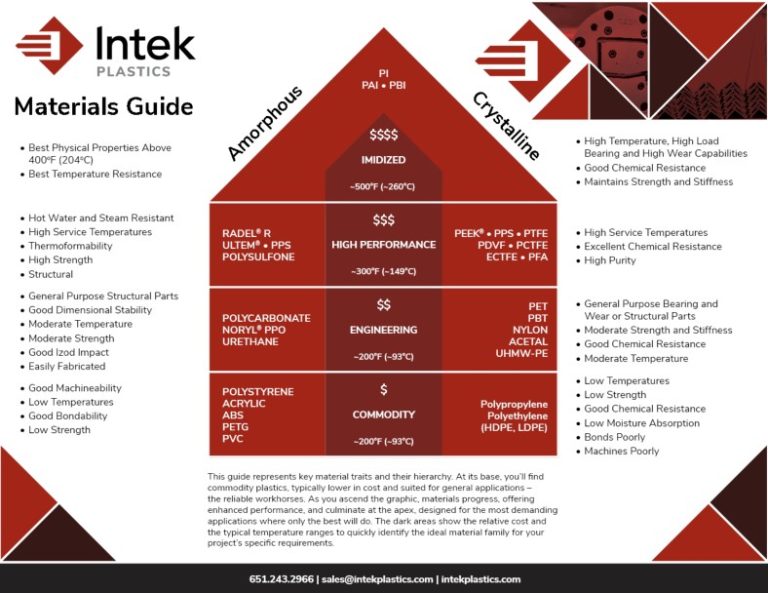
Amorphous
IMIDIZED: PI • PAI • PBI
HIGH PERFORMANCE: RADEL® R • ULTEM® • PPS • POLYSULFONE
ENGINEERING: POLYCARBONATE • NORYL® PPO • URETHANE
COMMODITY: POLYSTYRaENE • ACRYLIC • ABS • PETG • PVC
Crystalline
IMIDIZED: PI • PAI • PBI
HIGH PERFORMANCE: PEEK® • PPS • PTFE
PDVF • PCTFE • ECTFE • PFA
ENGINEERING: PET • PBT • NYLON • ACETAL • UHMW-PE
COMMODITY: Polypropylene •Polyethylene (HDPE, LDPE)
Yield Strength and Tensile Strength
These two mechanical properties are fundamental to understanding how a plastic material behaves under pulling forces.
 Yield strength is the point at which a material begins to deform permanently. Beyond the yield point, the material will not return to its original shape even if the load is removed.
 Tensile strength is the maximum stress a material can withstand while being stretched or pulled before breaking.
Understanding both is vital: Yield strength defines the safe operating limit for reversible deformation, while tensile strength indicates the material’s failure point under tension.
Amorphous Versus Crystalline Plastics
The internal molecular structure of a plastic significantly dictates its properties. Plastics are broadly categorized as amorphous or crystalline.
 Amorphous Plastics
- Structure: Molecules are randomly arranged, like spaghetti in a bowl.
- Properties: These tend to be transparent, soften gradually over a temperature range, are generally more prone to stress cracking and have lower chemical resistance.
- Applications: Ideal for clear enclosures, lenses, medical devices, food processing equipment and parts requiring tight tolerances.
 Crystalline Plastics
- Structure: Molecules have ordered, repeating structures, with both crystalline and amorphous regions.
- Properties: These are typically opaque or translucent, have a sharp melting point, generally possess better chemical resistance and are more resistant to stress cracking.
- Applications: Common in industrial components, pipes, gears, medical devices, food processing equipment and parts requiring durability and chemical resistance.
Stress and Temperature
Plastic’s mechanical properties are highly sensitive to temperature.
- Increased temperature generally leads to an decrease in strength, stiffness and hardness. Plastics become more flexible and ductile.
- Decreased temperature can lead to an increase in stiffness and strength but often at the expense of ductility, making the material more brittle and prone to fracture on impact.
Engineers must consider the full operational temperature range of a component, not just room temperature, to ensure material selection prevents premature failure.
Stress Cracking
The formation of cracks in a plastic may happen when it is subjected to tensile stress in the presence of certain chemicals or environments that would not cause cracking in an unstressed material.
- Cause: A complex interaction between internal or external stress and a chemical agent that attacks the polymer chains.
- Implications: Can lead to unexpected and premature failure of plastic parts, particularly those in contact with cleaning agents, lubricants or certain solvents. Material selection must account for both mechanical and chemical environments.
Our team is ready to help you find the best material fit for your project.
Quality Systems Designed for Reliability
Whether we’re producing high-volume extruded profiles or complex molded components, our quality framework ensures every step of manufacturing is controlled and repeatable. Our system includes:
- ISO 9001:2015 certification and standardized procedures
- Advanced measurement tools and statistical process control
- Material verification and traceability
- In-process inspections and final part validation
- Continuous improvement programs across extrusion and molding lines
This structured approach allows us to deliver reliable, high-performing parts that support your production goals and reduce your total cost of manufacturing.